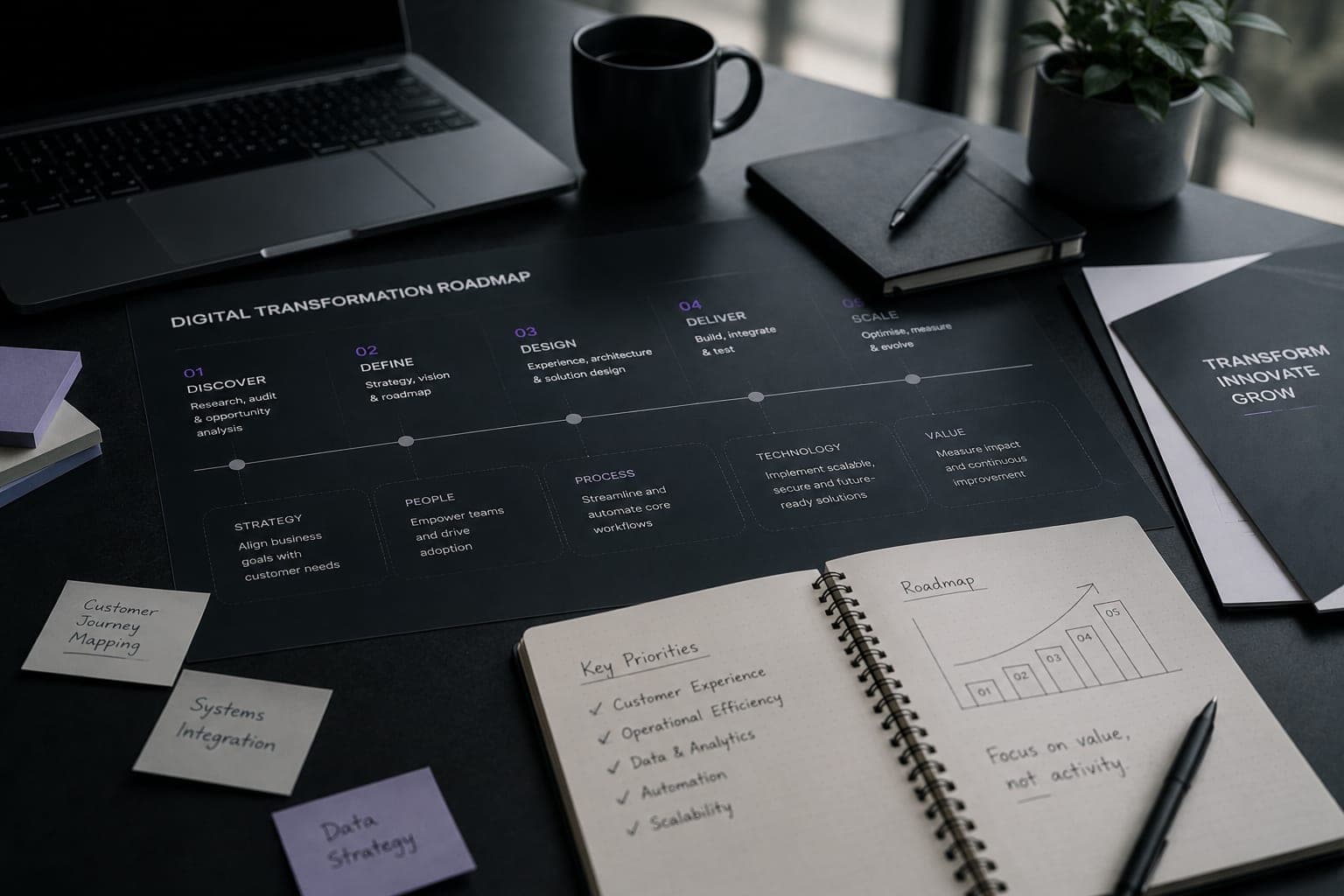
Most conversations about AI in business start with the technology and work backwards to a use case. That order produces expensive pilots that quietly get switched off.
This is the framework we use instead. It starts with your operations and only reaches the technology at the end.
Key takeaways
- Readiness is an operations question, not a technology question. Buying a tool does not create it.
- The best first use case is repetitive, high-volume and low-judgement, with a cost you can already measure.
- If nobody can name the number that should move, the initiative is positioning, not strategy.
- Volume decides viability. The same task is worth automating at two hundred repetitions a month and not at two.
The four questions
Run any proposed AI initiative through these in order. If it fails one, stop there.
1. What task, exactly?
Name a single, specific, repeated task. Not a department, not a goal. If you cannot describe it in one sentence, it is not ready to automate.
2. How often does it happen?
Count it for a week. Volume is what determines whether the setup cost is ever recovered. Low-frequency tasks almost never justify the effort.
3. What does it cost now?
In hours, errors or delay. This becomes your baseline. Without it you will never be able to prove the initiative worked.
4. What data does it need?
If it needs your own historical data, is that data complete and accessible? If it needs none, you can likely start immediately.
Most ideas fail at question two or three. That is the framework working, not failing.
Where the return usually is
In our experience the reliable wins cluster in a few places.
| Task | Why it works | What to measure |
|---|---|---|
| First-pass enquiry replies | High volume, low judgement, speed matters | Time to first response |
| Categorising and routing enquiries | Repetitive, rules-based, error-prone by hand | Misrouted percentage |
| Summarising calls and meetings | High volume, output checked by a human | Hours saved per week |
| Drafting first versions of copy | Editing is faster than starting blank | Turnaround time |
Notice what these have in common. A person remains in the loop, and the measure of success was defined before the work started.
Where it usually is not
Anything requiring real judgement about a specific customer. Pricing decisions, difficult negotiations, complaint resolution. The failure cost is high and the volume is low.
Anything built on data you do not actually have. A predictive model needs history. If your records live in three spreadsheets and someone's inbox, the project is a data project first.
Anything adopted because competitors announced it. That is a marketing decision being funded from an operations budget.
A readiness checklist
- You can name one specific task, in one sentence
- You have counted how often it happens
- You know what it currently costs in hours or errors
- You know what data it needs and whether you have it
- You have agreed the number that should move, before starting
- A human reviews the output before it reaches a customer
Six ticks means start. Four or five means fix the gaps first, and they are usually process gaps rather than technology ones.
This is the same logic that applies to any digital investment, which we set out in what digital strategy actually is.
Want an honest read on where AI would help?
Thirty minutes. We will look at your actual processes and tell you which one is worth automating and which are not, including if the answer is none yet.
Book an AI readiness session